How to Report Rental Income on Your Taxes: A Simple Guide for Self-Managing Landlords
If you own a rental property, the IRS requires you to report your rental income and expenses every year on Schedule E (Form 1040). For many self-managing landlords, the challenge isn't understanding the rules — it's having organized records when tax season arrives.
Between juggling tenants, coordinating maintenance, and keeping track of every receipt, sitting down to file your rental income taxes might be the last thing you want to do. But here's the good news: reporting rental income is straightforward once you understand the basics.
In this guide, we'll explain:
- What counts as rental income
- How Schedule E works
- The five expense categories every landlord should understand
- How to organize your records so filing is straightforward
We're not accountants and this article isn't tax advice — always work with a qualified tax professional for your specific situation. But understanding the fundamentals will help you show up to that meeting prepared.
How to report rental income on your taxes
If you own rental property, you report rental income and expenses on Schedule E (Form 1040) when filing your personal tax return.
To report rental income correctly, landlords typically follow these steps:
- Add up all rental income received during the year, including rent payments, late fees, pet fees, and any portion of security deposits kept.
- Track deductible expenses, such as repairs, property taxes, insurance, mortgage interest, and property management fees.
- Separate expenses into tax categories, including repairs & maintenance, operating expenses, capital improvements, and depreciable assets.
- Calculate your net rental income or loss by subtracting expenses from total income.
- Report the totals on Schedule E, which flows into your Form 1040.
The biggest challenge for most landlords isn't the tax rules — it's keeping organized records throughout the year so these totals are easy to calculate.
What counts as rental income
The IRS defines rental income broadly. It's not just the monthly rent check. If a tenant pays you money in connection with your rental property, there's a good chance it's taxable. Here's what the IRS expects you to report:
- Monthly rent payments: including rent paid by check, cash, direct deposit, or apps like Zelle and Venmo
- Late fees and early termination penalties
- Pet fees or additional parking fees
- Advance rent: if a tenant pays the last month's rent at lease signing, that amount is taxable in the year you receive it, not the month it applies to
- Kept security deposits: a security deposit is not taxable income when you receive it, but it becomes income the moment you keep any portion for unpaid rent or damages
- Non-cash payments: if a tenant paints your rental unit in exchange for a rent reduction, the fair market value of that service counts as income
The key principle: report everything you receive. Expenses get deducted separately, so never reduce your income figures by costs you've paid. The IRS wants to see the full picture on both sides of the ledger.
Schedule E 101: the form every landlord files
When you file your personal tax return (Form 1040), rental income and expenses go on Schedule E (Supplemental Income and Loss), Part I. This is the form that captures everything related to your rental real estate activity and flows the net result — profit or loss — into your overall tax return.
Schedule E lets you report up to three rental properties per form. If you own more, you attach additional copies. For each property, you'll list the total rents received, then deduct allowable expenses across specific line items such as mortgage interest, property taxes, insurance, repairs, and depreciation. The difference between your rental income and your deductible expenses determines whether you have a net gain or a net loss for each property.
A few things worth knowing: rental income is generally classified as passive income, which means losses may be limited in how they offset your other income. However, if your adjusted gross income is below a certain threshold and you actively participate in managing your property, you may be able to deduct up to $25,000 in rental losses against your regular income. Your tax professional can walk you through the passive activity rules that apply to your situation.
The 5 expense categories that matter most
This is where self-managing landlords leave the most money on the table. Knowing the difference between these five expense categories can mean the difference between a healthy deduction and a missed opportunity — or worse, an audit flag.
1. Repairs and Maintenance
These are costs that keep your property in its current condition without adding value or extending its useful life. Think of fixing a leaky faucet, patching drywall, replacing a broken window, or servicing the HVAC system. Repairs are fully deductible in the year you pay for them, which makes them the most immediately valuable category on your Schedule E.
2. Capital Improvements
Unlike repairs, capital improvements add value, extend the useful life, or adapt the property for a new use. Replacing an entire roof, installing a new HVAC system, remodeling a kitchen, or adding a deck all fall into this category. You cannot deduct capital improvements all at once. Instead, they're depreciated over time — typically 27.5 years for residential rental property. The distinction between a repair and an improvement is one of the most common areas where landlords make costly mistakes.
3. Operating Expenses
These are the recurring costs of running your rental business: insurance premiums, property management fees (if applicable), advertising costs for listing vacancies, legal and professional fees, and utilities you pay on behalf of tenants. All of these are deductible in the year incurred.
4. Depreciable Assets
Beyond the building itself, certain items you purchase for your rental property — appliances, furniture for furnished units, landscaping equipment — have their own depreciation schedules. These assets are deducted gradually over their useful life rather than all at once. Depreciation is one of the most powerful tools in a landlord's tax strategy. The IRS assumes you're claiming it whether you actually do or not, so skipping depreciation doesn't save you — it costs you.
5. Acquisition Costs
When you purchased the property, you likely paid closing costs, title fees, legal fees, and other transaction expenses. Many of these costs get added to your property's cost basis, which affects your depreciation calculation and your eventual gain or loss when you sell. Keeping these records from day one matters more than most new landlords realize.
What this looks like in practice
One of our early users, Mike, manages two rental properties abroad. For the most recent tax season, he used RentWise to organize every financial record related to those properties.
His workflow looked like this:
Capture every transaction
He uploaded receipts for repairs, contractor invoices, insurance, property taxes, and maintenance costs using RentWise's receipt and expense tracking. He also recorded:
- Rent payments received
- Mortgage payments (with principal vs. interest split)
- Insurance payments
- HOA fees
Categorize expenses for tax treatment
RentWise's expense tracking tool automatically suggested a tax category for each expense:
- Capital Improvement
- Repairs & Maintenance
- Operating Expense
- Depreciable Asset
- Acquisition Cost
A built-in tooltip explains how each category works so landlords can classify expenses correctly.
Export everything for tax filing
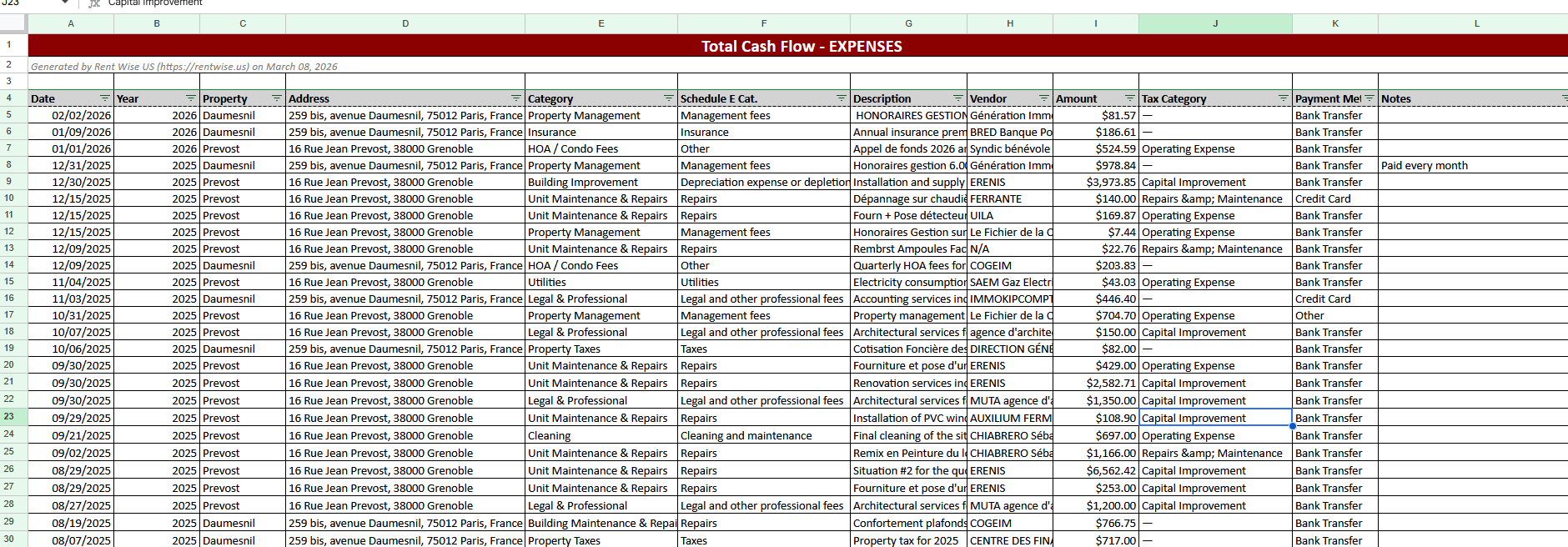
At tax time, Mike exported his complete transaction history using RentWise's free cash flow tracker and used pivot tables to calculate totals for each category before filing.
“For the first time, I reported the right amounts in the right categories with a level of granularity and accuracy I hadn't reached before.”
When all your income and expenses are properly tracked, your tax preparation becomes straightforward. Instead of digging through bank statements and receipts, you should be able to export a clean ledger showing:
- Transaction date
- Property
- Expense category
- Vendor
- Tax treatment
- Payment method
From there, totals can easily be calculated using pivot tables or accounting software.
Common tax mistakes self-managing landlords make
Even experienced landlords make small mistakes that can cost money at tax time. Here are some of the most common ones:
- Mixing personal and rental expenses: Using the same bank account makes it difficult to track deductible costs.
- Forgetting small expenses: Hardware store runs, cleaning services, or minor repairs add up over the year.
- Misclassifying repairs vs improvements: Calling a major renovation a repair can trigger IRS scrutiny.
- Missing depreciation entirely: Many landlords forget to depreciate assets like appliances or furniture.
- Reconstructing records at tax time: Trying to piece together receipts from email, bank statements, and memory almost always leads to missed deductions.
What happens when your records are messy
Disorganized records don't just make tax season stressful — they cost you real money. Here's what's at stake:
- Missed deductions: if you can't find the receipt for a $3,000 roof repair, you can't deduct it. Multiply that across several years and the missed savings add up fast.
- Misclassified expenses: calling a capital improvement a repair (or vice versa) can trigger IRS scrutiny. Getting the categories wrong means you're either overpaying now or facing penalties later.
- Audit exposure: the IRS looks for inconsistencies, round numbers, and missing documentation. Landlords who can't substantiate their deductions are exactly who audits are designed to catch.
- Tax-professional costs: the more disorganized your records, the more hours your CPA or tax preparer spends sorting through them. That's money straight out of your pocket before you even file.
The organized landlord's tax-prep checklist
Before you sit down with your tax professional — or open your tax software — make sure you have the following ready for each rental property:
- A complete income summary: total rent collected, security deposits kept, late fees, and any other payments received from tenants
- Mortgage interest statement (Form 1098) from your lender
- Property tax records showing total taxes paid during the year
- Insurance premium statements for landlord policies
- Categorized expense records — every repair, improvement, operating cost, and asset purchase, organized by type with receipts attached
- Depreciation schedules for the building and any depreciable assets
- Mileage logs for trips to your rental properties
- Vendor invoices and contractor payments, especially any totaling $600 or more (you may need to issue a 1099)
- Prior-year tax return for reference on depreciation carried forward and cost basis
Stop scrambling every April
The problem isn't that tax rules are complicated — it's that most self-managing landlords don't have a system that organizes this information as they go. They're reconstructing a year's worth of activity from scattered emails, text messages, bank statements, and shoeboxes of receipts.
RentWise automatically categorizes your expenses into the five tax-treatment buckets described above — Capital Improvement, Repairs & Maintenance, Operating Expenses, Depreciable Assets, and Acquisition Costs — as you enter them throughout the year. When tax time arrives, your records are already organized, categorized, and ready to hand off to your tax professional.
No more digging through spreadsheets. No more guessing whether that water heater was a repair or an improvement. You'll get a clean, exportable record that's been building itself all year.
Disclaimer: This article is for informational purposes only and does not constitute tax, legal, or financial advice. RentWise is a property management tool, not an accounting firm. Always consult a qualified tax professional for advice specific to your situation.